Looking for a horse property in North Salem is very different from shopping for a typical suburban home. You are not just buying square footage and curb appeal. You are also evaluating land use, barn function, drainage, trail access, and local rules that can shape what the property can actually support. If you want a smarter way to approach the search, this guide will help you focus on the details that matter most. Let’s dive in.
Why North Salem attracts equestrian buyers
North Salem offers a rare mix of rural character and regional access. The town describes itself as a community of about 5,000 residents with 24 square miles of open space, riding trails, and train access to New York City. That balance is a big reason buyers looking for horse properties and estates keep North Salem on their radar.
The area is not just scenic. North Salem’s open-space planning identifies active agricultural uses that include horse farms, orchards, cattle farms, hayfields, and vineyards. For you as a buyer, that means equestrian use is part of the town’s real landscape and land-use pattern, not just a lifestyle image.
Another major draw is the trail network. The town notes that the North Salem Open Land Foundation oversees more than 1,300 acres of permanently protected open land, while riders use more than 100 miles of bridle trails maintained by the North Salem Bridle Trails Association. That said, trail access should never be assumed just because a property looks close to open land.
Trail access needs close review
This is one of the biggest details to verify before you buy. According to the North Salem Open Land Foundation, Baxter Preserve is the only one of its preserves that allows public horseback riding. Other horseback routes may be marked by the North Salem Bridle Trails Association and can cross private property.
That distinction matters. Some trail connections may depend on membership and private-property access arrangements rather than rights that automatically transfer with a sale. In practical terms, you will want to confirm whether access is deeded, licensed, revocable, or simply informal.
If trail riding is one of your top priorities, parcel-specific due diligence is essential. A beautiful property near trails is not the same as a property with reliable legal access to them.
North Salem zoning for horse properties
In North Salem, horse use is regulated land use. It is not something to assume will be allowed on any residential parcel without review. Town Code §250-72 covers keeping horses on residential lots, along with uses such as boarding stables, breeding farms, and riding academies, as conditional-use or special-permit uses.
The town’s general standards require that a use fit the zoning district, protect nearby properties, avoid safety issues, and not create undue public burdens. That means the property itself is only part of the equation. You also need to know whether your intended use aligns with local requirements.
For many buyers, the most important takeaway is simple: do not assume a horse-capable-looking property is automatically approved for your planned use. The zoning and permit path can matter just as much as the acreage.
Key local standards to know
North Salem’s code includes several practical standards for horse properties. These can directly affect how many horses a property can support and how the site must function.
Important points include:
- As a general rule, no more than one horse per acre may be permitted
- One stable stall is required for each horse housed on site unless a stall is shown to be inappropriate
- Manure, stabling, and other dust-producing materials must meet minimum setbacks that vary by district
- Screening is required in certain situations
- Fences or walls must be at least four feet high in appropriate locations
- Outdoor riding lights cannot be visible at the source from adjoining property
If you are thinking about boarding, breeding, lessons, or hosting horse shows, the review can become more involved. Public horse shows, rodeos, and similar events are treated as principal uses for lot-area and setback purposes.
Watershed and land constraints matter here
North Salem sits within the East of Hudson Watershed, which the town describes as one of the most sensitive watersheds in New York State. This matters because some land development activity may require review related to stormwater, erosion and sediment control, and septic systems.
The town’s materials note that development in North Salem can involve New York City Department of Environmental Protection review of stormwater pollution prevention, erosion and sediment control, and septic systems. For you, that means changes to arenas, barns, driveways, paddocks, or drainage patterns may need more scrutiny than expected.
Topography is another major factor. North Salem’s open-space report describes streams, wetlands, steep hills, narrow valleys, and agricultural land. A property may offer impressive acreage on paper, but the truly usable portion can be much smaller once slopes, wet areas, and setbacks are considered.
What to inspect before you buy
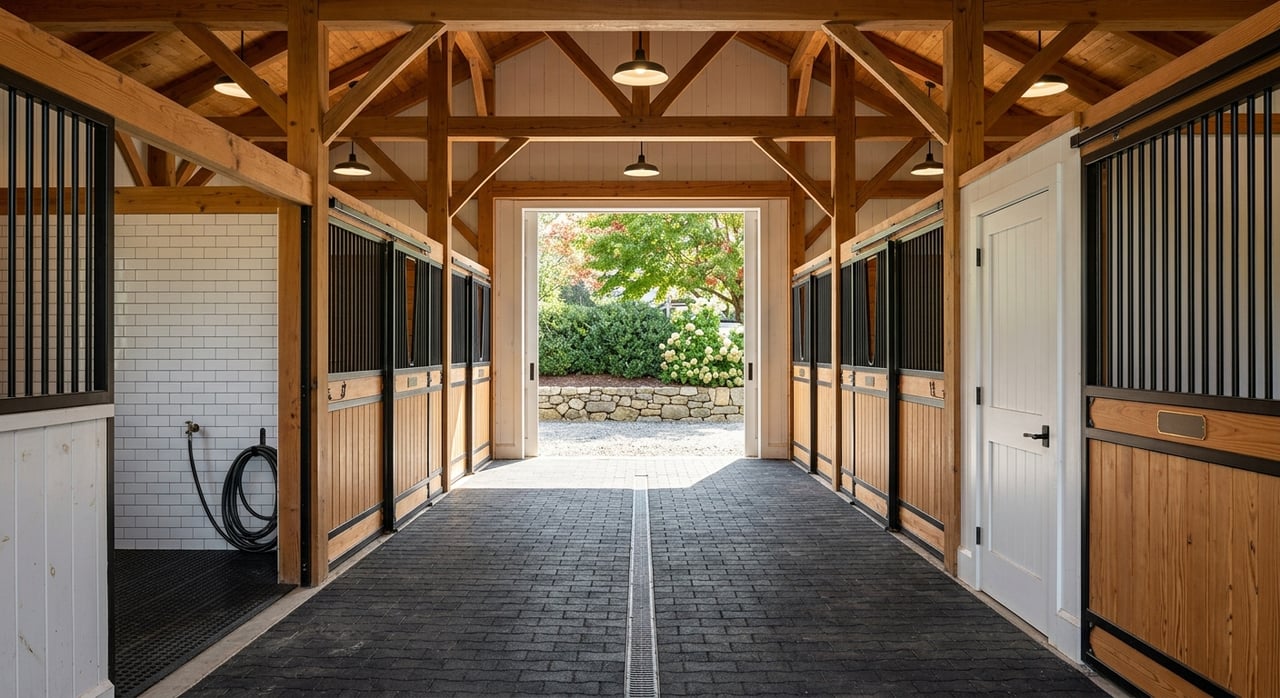
When you tour horse properties in North Salem, it helps to think beyond the house. Barns, paddocks, pasture layout, manure storage, and drainage should be evaluated like working components of a small livestock facility.
Extension guidance emphasizes safe space for horses and people, along with proper storage for hay and feed. It also recommends site planning that supports drainage, ventilation, and light. A good setup is not just attractive. It should work day to day.
Barn layout and function
A barn should support safe movement, storage, and routine care. You will want to look at stall count, circulation, ventilation, and the relationship between the barn, paddocks, and turnout areas. Efficient layout can make a big difference in both convenience and long-term maintenance.
Guidance on equine facility design also recommends arranging pasture and paddock areas centrally around the barn, work area, and feed storage. That type of layout can help a property function more smoothly, especially in bad weather or during busy care routines.
Pasture and paddock planning
Pasture math matters more than many buyers expect. In the Northeast, one Penn State source says 2 to 3 acres of good pasture per horse is generally needed for summer feeding, while University of Minnesota Extension notes that about 2 acres of pasture per grazing horse can reduce dependence on hay.
That does not mean every North Salem property needs that exact ratio to be workable. It does mean you should understand whether the land can support grazing, or whether you will rely more heavily on hay and a sacrifice paddock or dry lot system.
If the property cannot support full pasture turnout, a sacrifice area can help protect the rest of the land during wet seasons or low-growth periods. These areas should be planned with shelter, water, and feeders in mind.
Drainage is often the deal-breaker
Drainage is one of the most important issues to assess on any North Salem horse property. Wet ground, runoff, and poor grading can affect paddocks, riding areas, manure storage, and barn usability. In a town known for steep hills, wetlands, and watershed sensitivity, this deserves serious attention.
Extension guidance notes that sacrifice areas may need hoof-friendly footing, regular manure removal, and in some cases subsurface drainage where high water tables exist. Manure storage should also be placed with drainage, nearby water, and neighboring properties in mind.
Before you fall in love with an arena location or barn addition, make sure the grading and runoff pattern make sense. A beautiful setup in dry weather can perform very differently after sustained rain.
Agricultural district status and taxes
North Salem includes a large share of Westchester County Agricultural District Number One. Of the district’s 9,254 acres, 3,832 acres are in North Salem. That makes agricultural-district status an important topic for some buyers considering larger parcels.
Still, it is important to be precise here. Agricultural-district inclusion and agricultural assessment are not the same thing as automatic tax savings on the entire property. Under New York’s agricultural-assessment rules, the benefit applies to eligible land, not the residence or most improvements, and owners must apply to receive it.
Commercial horse boarding may qualify if acreage, horse-count, and gross-receipts standards are met. If favorable tax treatment is part of your purchase strategy, you will want to review current eligibility carefully rather than assume it comes with the property.
North Salem horse property price ranges
The broader North Salem housing market gives only part of the picture. Redfin reported a median sale price of $951,509 for the three months ending April 2026, with homes averaging 71 days on market. For horse buyers, though, that median is usually not the most useful benchmark.
Public examples show a much wider range for horse-capable homes and estates. In May 2026, one 3.27-acre property on Vail Lane was listed at $1,195,000, while a 2-acre property on Hunt Lane was listed at $1,595,000. A property on Finch Road sold in March 2026 for $2.6 million, and a large 83.32-acre estate on Hardscrabble Road appeared publicly in roughly the $7.265 million to $7.999 million range depending on source and date.
A practical takeaway is that entry-level horse-capable homes can start in the low $1 millions, more complete equestrian properties often fall in the $1.5 million to $3 million-plus range, and trophy estates can rise into the $7 million to $8 million-plus tier. Those ranges are based on public examples, not a formal market index, but they help set expectations.
Carrying costs can vary sharply
Taxes are another area where horse-property buyers need to think beyond the list price. Public listing examples showed 2025 taxes of $18,317 for a 3.27-acre property, while the 83.32-acre Hardscrabble estate was associated with annual taxes of $137,718.
That kind of spread reflects how much acreage, improvements, and estate scale can change the ownership picture. When you compare options, it helps to evaluate not just purchase price but also ongoing carrying costs and likely maintenance demands.
A smart due diligence team
Horse properties usually require a broader review than standard residential homes. Based on North Salem’s zoning, drainage, septic, and land-use considerations, it makes sense to build a practical advisory team early.
That team often includes:
- An equine veterinarian
- A septic and well professional
- A surveyor
- A barn or structural inspector
- An attorney or land-use adviser familiar with North Salem zoning and watershed rules
This kind of support can help you understand not just the property’s current condition, but also whether it fits your long-term goals. That is especially important if you are relocating from the city or buying your first horse property in Northern Westchester.
How to shop more confidently in North Salem
The best horse-property searches start with clarity. Before touring too many listings, define what matters most to you: number of horses, turnout needs, trail access, barn condition, future improvements, commute priorities, and budget for carrying costs.
From there, it becomes much easier to separate a beautiful estate from a truly functional equestrian property. In North Salem, the right purchase is usually the one where the land, local rules, and your intended use all line up.
If you are planning a move to North Salem or comparing equestrian options across Northern Westchester, having local guidance can save you time and help you avoid costly assumptions. For personalized help finding the right fit, schedule a consultation with Jessica Broomhead.
FAQs
Can you keep horses on any residential lot in North Salem?
- No. North Salem regulates horse use through conditional-use or special-permit standards, along with other zoning rules such as setbacks and site requirements.
Does trail access transfer automatically with a North Salem horse property sale?
- Not necessarily. Some riding routes depend on North Salem Bridle Trails Association membership and private-property access arrangements, so access should be verified for the specific parcel.
Can you board horses at a North Salem property?
- Possibly, but boarding is a regulated use under North Salem code and may require additional zoning review and compliance with local standards.
Can you host horse shows or equestrian events in North Salem?
- Possibly, but public horse shows, rodeos, and similar events are treated as principal uses for lot-area and setback purposes, which can trigger added review.
Does agricultural-district status automatically reduce taxes on a North Salem horse property?
- No. Agricultural assessment must be applied for, the land must meet state eligibility requirements, and the residence itself is not the part that typically receives the assessment.
What acreage should you look for in a North Salem horse property?
- It depends on your intended use, but local code generally allows no more than one horse per acre, and extension guidance suggests about 2 to 3 acres of good pasture per horse for summer feeding in the Northeast.